Code is a narrative. We write it in acts.
Our pipeline isn't a factory line; it's a story arc. We start with a whispered idea and end with a polished world where every line of code serves the player's experience. This is how we build games that feel inevitable, not just functional.
Constraint-Driven
"We don't fight the platform; we design for it. The 30fps limit on mobile became the heartbeat of 'Pocket Canvas'."
1. Narrative-First
Mechanics are prototyped from story beats, not feature lists. The 'time dilation' in our recent title was a plot device before it was a code function.
2. Transparent Gates
Clients receive a playable build every Friday during production. No black-box development. Your feedback is a core input to the iteration loop.
3. Polish is a Phase
We dedicate a full sprint solely to the 0.2-second rule, haptic feedback, and audio-visual sync. This is where good becomes unforgettable.
From Spark to Ship: The 5-Phase Pipeline
A transparent framework for predictable delivery. Each phase has a clear purpose, a deliverable, and a client sign-off gate.
Concept & Feasibility
2–3 Weeks
Mood boards, core loop validation, and technical risk assessment. We prove the idea is viable before a single line of production code is written.
Vertical Slice
4–6 Weeks
A fully playable, 5-minute segment. This proves the visual style, audio direction, and—most importantly—the "fun factor."
Production Sprint
Variable
Agile sprints. Clients receive a live build link every Friday. We work in visible, incremental progress.
Alpha & Beta Gates
3–4 Weeks
Feature-complete at Alpha. Beta is polish-focused. We use a 'bug budget' system for prioritization—critical issues only.
Launch & Live Ops
Ongoing
Launch monitoring, A/B testing for retention, and planning content updates. We don't vanish on ship day.
Pipeline Insight: The Friday Build
The single most important ritual. Every Friday at 18:00 CET, clients get a clickable build via a shared link. It's not a presentation; it's a conversation. We've found this eliminates 90% of end-project surprises and keeps momentum aligned.
The Crucible: Where Ideas Are Stress-Tested
Development isn't linear. It's a loop of hypothesis, test, and often, demolition. Here’s a look into the raw process.
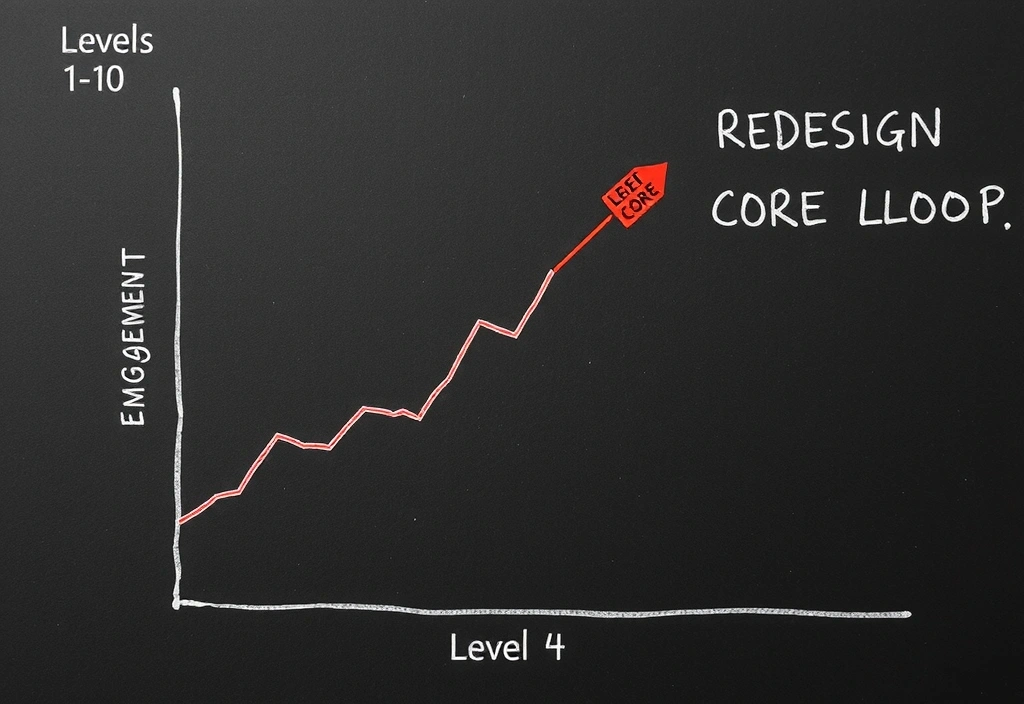
The 'Fun Graph' Evidence
During the Beta for 'Echoes of the Deep', our playtest data showed a catastrophic drop in player engagement starting at Level 4. Instead of patching the symptom, we re-architected the level from the ground up based on this single data point.
Trade-off: Time vs. Retention"We chose a stylized, cel-shaded look for 'Aether' to hit 60fps on all target devices. That constraint didn't limit us; it became our signature style."
— Lead Artist, on Visual Fidelity vs. Performance
This wasn't a loss; it was a creative mandate. The uniform lighting allowed us to master mood and silhouette, creating a distinct visual identity that players remember.
Mini Scenario: The 72-Hour Bug Hunt
Decision Criteria
We chose to fix the root cause (audio middleware interaction) over the symptom (physics bug), even though it was faster to mask the symptom. Long-term stability over short-term speed.
The Tools of the Modern Artisan
Our stack isn't a random collection of software; it's a curated set of instruments. Each tool is chosen for how it amplifies creativity, not just functionality.
Unity as Canvas
We use its 2D pipeline for painterly UI and frame-by-frame animation. The engine is a neutral canvas; the artistry is in how we wield it.
The 'Italian Light' Shaders
A proprietary library that mimics Renaissance chiaroscuro. It’s the technical soul of our visual identity.
Wwise for Spatial Storytelling
Audio isn't an effect; it's a positional narrative. We design soundscapes that react to player location, not just triggers.
Our Methodology Glossary
A fixed budget of bug-fix time for a sprint. Forces ruthless prioritization over perfectionism.
The final dedicated sprint. No new features. Only micro-interactions, haptics, and audio-visual sync. It's where magic happens.
We write story beats before we write code specs. A mechanic that doesn't serve the narrative is cut, even if it's technically impressive.
We treat battery life, screen size, and legacy code as creative prompts, not obstacles. This is where unique solutions are born.
Method Note: Evaluating Robustness
We don't just measure uptime. Before selecting a tool, we run a 2-week sandbox test on a real dataset, monitoring for hidden integration costs, learning curve, and documentation quality.
"A tool that looks perfect on paper but lacks good support will sink a project timeline. We've learned this the hard way."
Ready to Build Your Story?
Let's discuss your concept and see how our narrative-driven pipeline can bring it to life. The first consultation is always on us.
Via Roma 123, 00100 Roma, Italy +39 06 12345678 info@dataviox.pro
Mon-Fri: 9:00-18:00 CET